
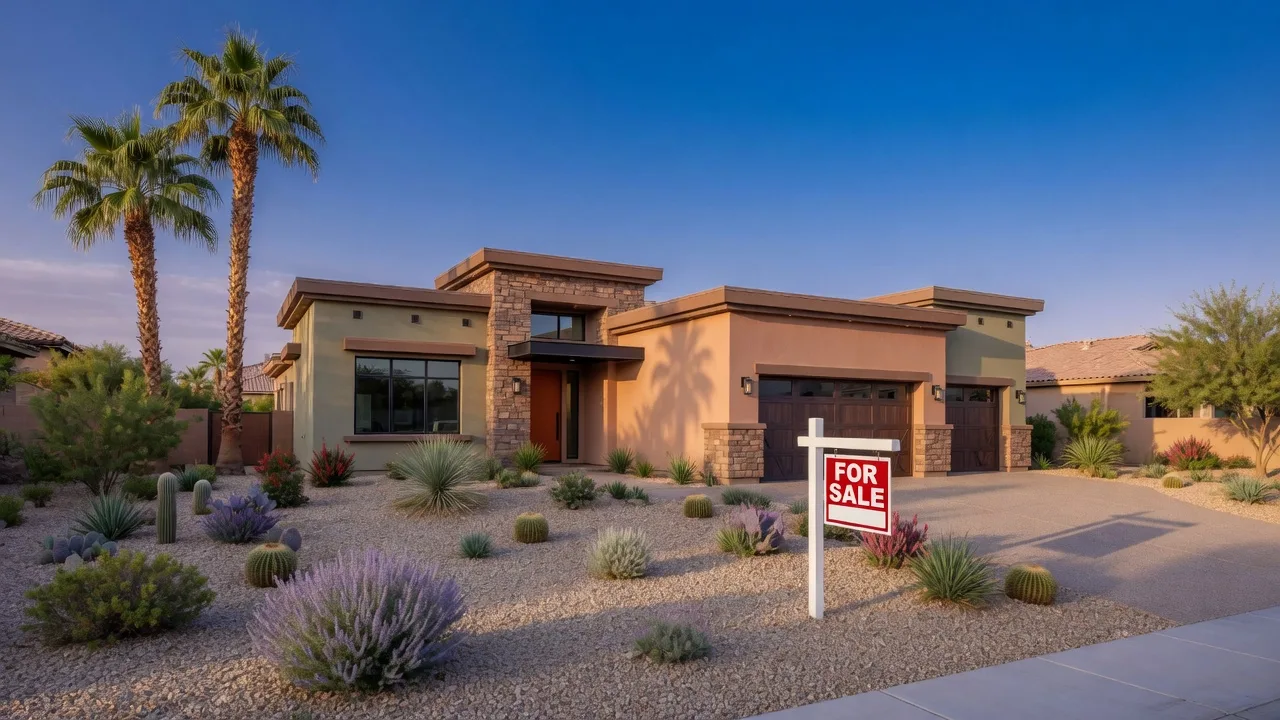
I became a real estate agent because I believe homeownership is the single most accessible path to building real, lasting wealth for everyday families. I lived it myself, and I have seen it transform the financial futures of the clients I serve across the Las Vegas Valley. Whether you are buying your first home in Mountain's Edge or sitting on years of equity in your Summerlin property, your home is more than a place to live. It is your most powerful wealth-building tool.
Here is how Las Vegas homeowners can actively build equity through smart financial strategies right now.
How Equity Builds: The Two Engines
Home equity grows through two mechanisms. The first is market appreciation, which is largely outside your control but has been remarkably consistent in the Las Vegas Valley. The second is principal paydown, which you can actively influence through your payment choices.
At the current valley median of $490,000, a 3.7 percent annual appreciation rate adds roughly $18,130 in equity each year. Meanwhile, a typical 30-year fixed mortgage at 6.55 percent pays down about $5,800 in principal during the first year on a $400,000 loan. Combined, that is nearly $24,000 in equity growth per year without any extra effort.
The question is: how much faster can you build equity if you are intentional about it? The answer, as it turns out, is significantly.
Strategy 1: Accelerate Your Principal Paydown
The simplest way to build equity faster is to pay down your loan principal more quickly. Here are three approaches that work well for Las Vegas homeowners:
Bi-Weekly Payments
Split your monthly mortgage payment in half and pay every two weeks. Because there are 26 bi-weekly periods in a year (versus 12 months), you make the equivalent of 13 full payments per year instead of 12. That one extra payment per year goes entirely to principal and can shave 4 to 5 years off a 30-year mortgage, saving tens of thousands in interest. Most lenders will set this up automatically at no cost.
Round Up Your Payment
If your monthly payment is $2,536, round it up to $2,600 or $2,700. That extra $64 to $164 per month goes entirely to principal. Over a year, that is $768 to $1,968 in additional principal paydown. Over the life of the loan, it can reduce your interest costs by thousands and build equity years faster. It is a small shift that compounds meaningfully.
Annual Lump Sum or Mortgage Recast
Got a bonus, tax refund, or side income? Applying a lump sum directly to principal is one of the most powerful equity-building moves you can make. Even one extra payment of $5,000 per year can eliminate 7 to 9 years from your mortgage. For homeowners with significant cash on hand, a mortgage recast allows you to make a large principal payment and have your lender recalculate your monthly payment at a lower amount, keeping your rate and loan term intact. This is not a refinance, so there are no credit checks or closing costs, just a small administrative fee.
Strategy 2: Smart Home Improvements That Build Value
Not all home improvements are created equal. In the Las Vegas market, certain upgrades deliver strong returns while others cost more than they add to your home's value. Here is what the data shows for 2026:
| Project | Avg. Cost | Resale Value | ROI |
|---|---|---|---|
| Garage Door Replacement | $4,500 | $8,100 | ~80% |
| Manufactured Stone Veneer | $11,000 | $17,000 | ~55% |
| Minor Kitchen Refresh | $27,000 | $41,000 | ~52% |
| Energy-Efficient Windows | $21,000 | $31,000 | ~48% |
| HVAC Replacement | $11,000 | $15,000 | ~36% |
| Swimming Pool (New) | $55,000 | $13,000 | ~24% |
| Upscale Master Suite Addition | $150,000 | $52,000 | ~35% |
The pattern is clear. Curb appeal projects like garage doors and exterior stone veneer deliver the highest percentage returns. Kitchen refreshes (new countertops, hardware, paint, and appliances) work well because buyers gravitate toward move-in-ready homes. And energy-efficient upgrades offer a double benefit: they add value at resale and save you money on monthly utility bills while you live in the home.
Pools, on the other hand, are a lifestyle choice, not an investment. In the Las Vegas heat, many buyers view pools as maintenance and expense rather than a feature worth paying extra for. If you want a pool for your family, build it. Just do not expect it to increase your home's resale value.
Strategy 3: Take Advantage of Nevada Rebates and Incentives
Nevada homeowners have access to programs that make energy-efficient upgrades more affordable than ever. NV Energy offers rebates for smart thermostats, HVAC tune-ups, evaporative cooler installation, and insulation upgrades. The Southwest Gas Rebate Program provides incentives for high-efficiency water heaters and furnaces. And the Nevada Energy Efficiency Portfolio Standard (EEPS) program can offset the cost of whole-home energy assessments.
These programs pay you to increase your home's value and lower your monthly bills. That is a rare triple win: lower expenses now, higher equity later, and a better-performing home in between.
Example: A Las Vegas homeowner installs a high-efficiency HVAC system for $11,000. After NV Energy rebates of roughly $500 and a Southwest Gas rebate of $300, the net cost drops to $10,200. The system saves the homeowner roughly $400 per year in energy costs. At resale, the upgrade adds approximately $4,000 in value. Within five years, the system has effectively paid for itself through savings and equity.
Strategy 4: Leverage Your Equity Without Overextending
Once you have built meaningful equity, you have options. A Home Equity Line of Credit (HELOC) or cash-out refinance can fund renovations, consolidate high-interest debt, or provide capital for a down payment on an investment property. The key is using leverage strategically, not recklessly.
Here is the rule I share with every client. Only tap your equity for things that will increase your net worth or your quality of life in a measurable way. Using a HELOC to renovate your kitchen adds value to your home. Using it to buy a car that depreciates 20 percent the moment you drive it off the lot does not. The math needs to work in your favor, not your lender's.
With the valley's median home price up $140,000 since 2021, many Las Vegas homeowners have more equity than they realize. If you bought a home in 2020 or 2021 at the valley median of roughly $350,000, your equity today is likely in the range of $120,000 to $180,000, depending on your down payment and how much principal you have paid down. That is real financial power.
The Financial Literacy Foundation
None of these strategies work without a foundation of financial literacy. Understanding your credit score and how to improve it, knowing the difference between gross and net equity, recognizing the long-term impact of small monthly choices, these are the skills that separate homeowners who build wealth from those who simply pay a mortgage.
That is why I put education at the center of every client relationship. I do not just want to help you buy or sell a home. I want to help you understand how that home fits into your broader financial picture, how to maintain and grow its value, and how to use it as a stepping stone to your next goal, whether that is a larger home, a retirement property, or a legacy for your children.
The families who build the most wealth through real estate are not the ones who make the biggest down payments or buy the most expensive homes. They are the ones who understand how the system works and make consistent, intentional decisions over time.
Where To Start: Your Equity Checkup
Not sure where you stand? A simple equity checkup gives you the clarity to make informed decisions. Here is what you can do today:
- Pull your current mortgage balance from your lender's portal or statement
- Look up recent comparable sales in your neighborhood on GLVAR or ask me for a personalized market analysis
- Subtract your loan balance from your home's current market value. That is your equity
- Subtract 6 to 8 percent for estimated selling costs (commission, closing costs, transfer taxes) to get your net equity
- Review your options: stay and build, sell and move up, or tap your equity for improvements
You may be closer to your next goal than you realize. The worst financial decision is the one you make without understanding your full picture. Let us change that.
Equity strategies play out differently across ZIPs: Summerlin (89135, 89138, 89144), Mountain's Edge (89178), and the Southwest (89139, 89141, 89148). Explore the current market in each on my live search: Search homes in the Las Vegas Valley.
Not sure how much equity you have or what to do with it?
I offer a free, no-obligation equity checkup for Las Vegas Valley homeowners. We will look at your home's current value, your remaining loan balance, and map out a strategy that fits your goals. No pressure, just clarity.