
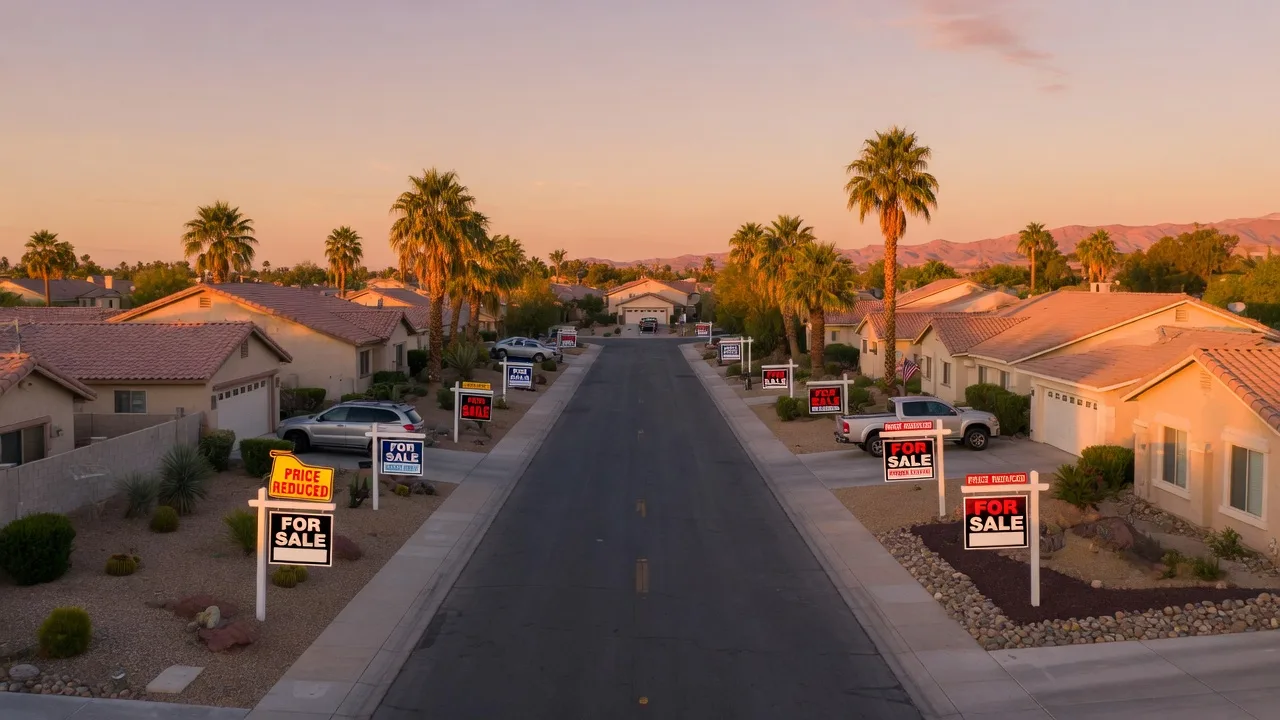
If you have been watching the Las Vegas Valley real estate market this summer, you may have noticed something that would have been unthinkable just two years ago: price reductions. Not just a few here and there, but on more than 5,100 active listings across the valley. According to the latest MLS data, 43.4 percent of all homes currently on the market have had at least one price cut, with a median reduction of $18,900.
If you are a buyer, that number might make you feel like you have the upper hand. If you are a seller, it might make you nervous. The truth is more nuanced. The price cut data is not a signal that the market is crashing. It is a signal that the market is normalizing after years of pandemic-era frenzy. And understanding how to read this signal is the difference between making a smart move and making a costly one.
The Big Picture: From Frenzy to Balance
To understand why so many homes have price cuts, you have to look at the broader market structure. The Las Vegas Valley now carries approximately 11,878 active listings across all property types, with months of supply at 3.6. That is a dramatic shift from the 1.5 to 2 months of supply that defined the market from 2021 through 2024, and it places us squarely in balanced territory for the first time since before the pandemic.
For context, a balanced market is generally defined as three to six months of supply. At 3.6 months, neither buyers nor sellers hold all the cards. The market is pricing itself efficiently, which means homes that are positioned correctly sell at or near their list price, while homes with optimistic pricing sit and accumulate days on market until the seller adjusts.
This is healthy. It is how real estate markets are supposed to function. During the pandemic years, the market was anything but normal, and the price cuts we are seeing now are not a correction in the traditional sense. They are the market finding its equilibrium after a period of extreme imbalance.
What $18,900 Tells Us
The median price reduction of $18,900 on affected listings is significant, but it is important to put it in perspective. On a $480,000 home, a $18,900 cut represents roughly 3.9 percent off the original list price. That is not a fire sale. It is a pricing correction.
Most of these reductions fall into two categories. The first is the overpriced home. A seller who looked at comparable sales from three or six months ago and priced at the top of the range, or above it, finds that today's buyers are not willing to pay yesterday's prices. After 30 to 45 days on the market with minimal showings, the seller adjusts to meet the market.
The second category is the motivated seller. Life happens. A job relocation, a divorce, an inherited property, or a financial need creates pressure to sell within a specific timeframe. These sellers are willing to reduce price to generate activity and secure a deal.
The key insight is that homes priced correctly from day one are not the ones carrying price cuts. They are going under contract in 20 to 35 days at or very close to their original list price. The price cuts are concentrated among listings that started too high, and that is a solvable problem with the right pricing strategy.
What This Means for Buyers
If you are a buyer in the Las Vegas Valley right now, you have more leverage than at any point in the last five years. Here is how to use it wisely.
What This Means for Sellers
If you are a seller, the message is not that you should panic. Prices remain at or near all-time highs. Buyer demand is steady. But the rules of the game have changed, and the most important rule is this: price it right on day one.
Homes that launch at the right price in the current market are selling in 20 to 35 days at 97 to 100 percent of list price. Homes that launch above market value sit for 60 days, get a price cut, sit for another 30 days, get another cut, and ultimately sell for less than they would have if priced correctly from the start. The data is clear: the first two weeks on the market are when your home gets the most attention from serious buyers. If you miss that window, you lose momentum.
Work with your agent to set a competitive price. I know it is tempting to aim high and see what happens. In today's market, that strategy backfires. A comparative market analysis based on closed sales from the last 90 days, adjusted for current conditions, gives you a price that attracts offers rather than stares.
Plan for concessions. With roughly 40 percent of transactions including seller concessions, building flexibility into your pricing strategy is smart. Offering a 2-1 rate buydown or 3 percent toward closing costs can make your home more attractive to buyers who are rate-sensitive without requiring a reduction in the sale price.
Invest in presentation. With more than 11,800 homes on the market, buyers have options. A home that is staged, cleaned, and photographed professionally stands out. Staging does not have to be expensive. Even a deep clean, fresh paint in neutral tones, and decluttering make a measurable difference in how quickly a home sells and at what price.
The Submarket Story: Where Price Cuts Are Concentrated
The 43.4 percent price cut rate is a valley-wide average, but the story changes significantly by submarket. The condo and townhome segment leads the valley in price reductions, consistent with the 24 percent year-over-year inventory surge in attached housing. In some condo complexes, more than half of active listings have seen at least one reduction. This is where buyers have the most negotiating power.
In the single-family home market, price cuts are concentrated in a few categories: homes in the $350,000 to $450,000 range that compete with new construction incentives, homes in outer-ring neighborhoods with longer commutes, and homes that need updates and are priced as if they were turnkey. In premium submarkets like Summerlin West and MacDonald Highlands, price cuts are less common because those neighborhoods have tighter inventory and higher demand.
The practical takeaway for buyers is that your negotiating leverage varies by neighborhood. In Henderson's Green Valley or Summerlin's established villages, you may have less room to negotiate than in the southwest valley or North Las Vegas. I always tell my clients the same thing: we look at the micro-market data for the specific neighborhoods you are targeting, not the valley-wide averages.
The Mortgage Rate Factor
Mortgage rates are hovering around 6.67 percent for a 30-year fixed-rate loan as of early August, up slightly from the 6.50 to 6.58 percent range we saw through late July. With the Federal Reserve expected to hold rates steady at the September meeting, we are likely to see rates settle in the 6.3 to 6.8 percent range through year-end.
Here is what I tell buyers who are watching rates. At 6.67 percent, the monthly payment on a $400,000 loan is roughly $2,570. If rates drop to 6 percent in a year, that payment falls to about $2,398, a savings of $172 per month. That is real money. But if you wait a year and home prices appreciate 3 percent, the same home costs $14,400 more. The math on waiting often does not work in your favor.
For sellers, the rate environment means you are competing not just with other resale homes but also with new home builders who are offering aggressive rate buydowns and closing cost credits. Understanding what builders in your area are offering helps you position your home competitively.
The Bottom Line
The Las Vegas Valley market in August 2026 is the most balanced it has been since before the pandemic, and the 43 percent price cut statistic is the clearest evidence of that shift. It is not a warning sign. It is an invitation to participate in a market that works for everyone.
For buyers, it means you can negotiate. For sellers, it means you need to be strategic. For everyone, it means that the decisions you make should be driven by data, not fear or FOMO. My job is to help you understand what the numbers mean for your specific situation, and to guide you through every step of the process with clarity and honesty.
Whether you are ready to buy, thinking about selling, or just starting to explore what is possible, I would love to sit down with you and look at the data that matters most to your future. There is no pressure, no sales pitch, and no obligation. Just real guidance from someone who treats your financial future as seriously as her own.
Price cuts concentrate in specific ZIPs, so your search should too: Summerlin (89135, 89138, 89144), Henderson (89002, 89012, 89014, 89015, 89044, 89052, 89074), and North Las Vegas (89030, 89031, 89032, 89081, 89084, 89086). See the current bargains on my live search: Search homes in the Las Vegas Valley.
Let us build a strategy that fits this market.
Whether you are buying, selling, or just curious about your home's value, I will help you navigate today's market with confidence and clarity. No agenda, just honest guidance.