
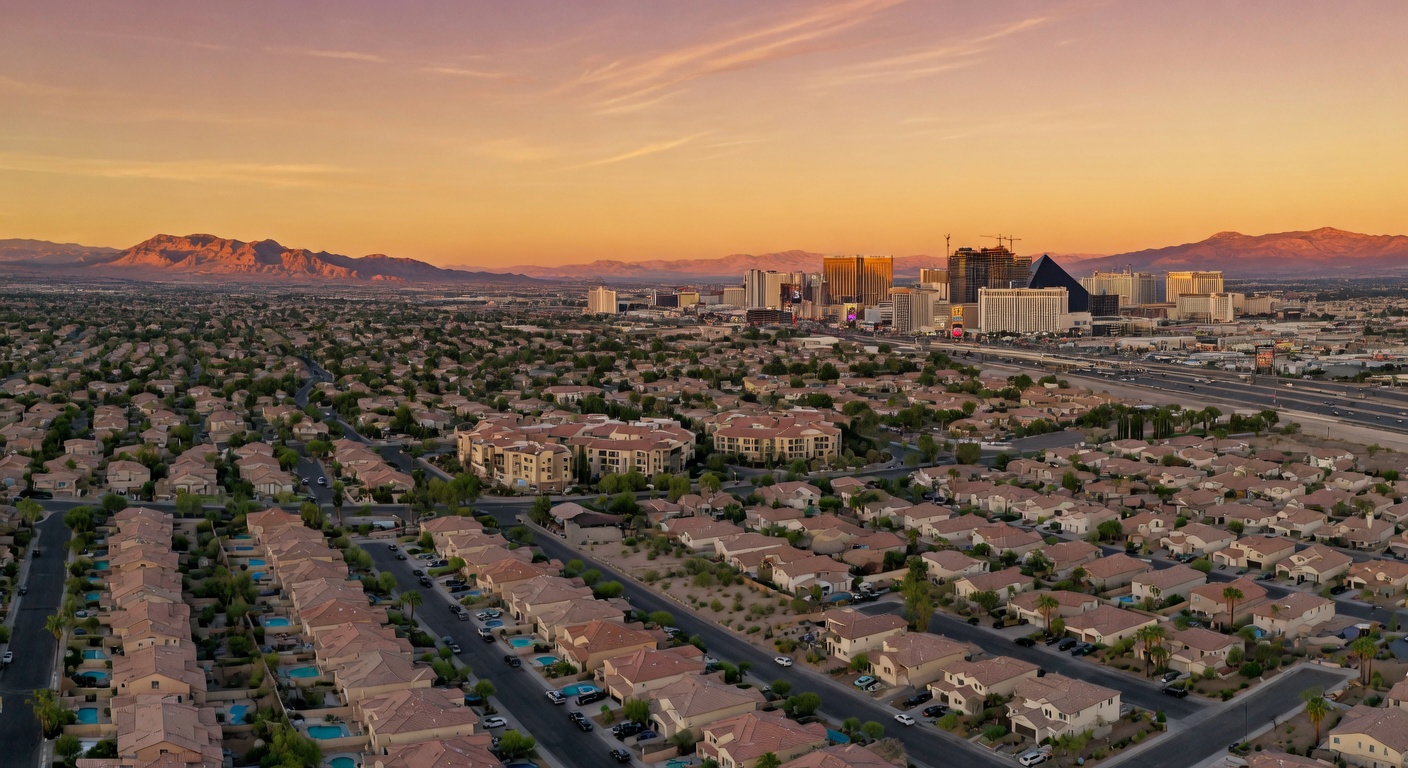
Las Vegas has long been known as the entertainment capital of the world, but in recent years it has quietly become one of the most popular relocation destinations in the United States. In 2025, more people moved to Nevada than left, and the Las Vegas metropolitan area accounted for the vast majority of that inbound migration. Remote workers, families, retirees, and professionals from across the country — and increasingly from California and Washington — are choosing southern Nevada for its combination of affordability, tax advantages, growing job market, and lifestyle.
If you are considering a move to the Las Vegas Valley, this guide covers what you need to know about the housing market, the communities, the financial advantages, and the practical realities of making southern Nevada your home. I have helped relocating buyers find the right neighborhood and the right home, and the questions below reflect what I hear most often.
Where Are New Las Vegas Residents Coming From?
According to recent migration data, California remains the single largest source of inbound residents to the Las Vegas Valley, with Los Angeles and the San Francisco Bay Area leading the way. Washington state — particularly the Seattle metro — is the second-largest source. The driving force behind both migrations is familiar: high housing costs, high state income taxes, and a growing acceptance of remote work have made Las Vegas an attractive alternative for people who no longer need to be physically present in their previous cities.
The migration is not just about affordability on paper. Las Vegas has invested heavily in infrastructure, healthcare, education, and commercial development over the past decade. The economy has diversified beyond tourism into technology, logistics, healthcare, and professional services. Companies like Switch, the Vegas Golden Knights organization, and numerous healthcare systems have created a more varied employment base. For remote workers, the combination of no state income tax, a lower cost of living compared to coastal cities, and year-round sunshine makes the value proposition genuinely compelling.
How Does Las Vegas Affordability Compare?
The valley-wide median single-family home price in spring 2026 sits at approximately $498,000. That number means something very different depending on where you are relocating from. For buyers coming from coastal California, where median home prices in Los Angeles, San Diego, and the Bay Area routinely exceed $800,000 to $1.2 million, Las Vegas represents a dramatic increase in purchasing power. A $500,000 budget in Las Vegas gets you a well-appointed 3-bedroom home in a master-planned community with parks, trails, and amenities — a property that would be unattainable at that price point in most California metros.
For relocators from more affordable markets in the Midwest or Southeast, the calculus is different. Las Vegas is not the bargain it was a decade ago. The median price has increased approximately 45 percent since 2019, and neighborhoods like Summerlin and Henderson command premiums that may surprise buyers accustomed to lower-cost regions. The key is to work with a local agent who understands neighborhood-level pricing so you can find the community that matches both your expectations and your budget.
The Tax Advantage: No State Income Tax
Nevada's lack of a state income tax is one of the most frequently cited reasons for relocation, and for good reason. For a household earning $150,000 annually, moving from California (with a top marginal rate exceeding 12 percent) to Nevada represents roughly $15,000 to $18,000 in annual tax savings. Over a five-year period, that is $75,000 to $90,000 that stays in your pocket — money that can be directed toward a down payment, home improvements, or investment.
The trade-offs are real and worth understanding. Nevada's sales tax is higher than the national average, property taxes are moderate (typically 0.5 to 0.8 percent of assessed value), and utility costs — particularly summer electricity — are higher than in many regions. But for most relocating households, the income tax savings more than offset these costs. The net financial benefit of relocating to Nevada is particularly strong for remote workers, business owners, and high-earning professionals.
Which Neighborhood Is Right for You?
One of the biggest mistakes relocating buyers make is assuming that Las Vegas is a single, uniform market. It is not. The valley contains dramatically different communities, each with its own character, price point, school quality, and lifestyle. Choosing the right neighborhood is arguably more important than choosing the right house.
Quick Neighborhood Guide for Relocators
Practical Considerations for Relocating Buyers
Moving to Las Vegas from out of state involves some logistical challenges that are worth addressing proactively. Here are the most common issues I see with relocating buyers:
- Buy before you sell (if possible). The Las Vegas market moves quickly in desirable neighborhoods. If your financial situation allows, getting pre-approved and making an offer on a Las Vegas home before listing your current home gives you a significant advantage. I can coordinate timing strategies with your out-of-state agent.
- Virtual and remote buying support. I regularly work with out-of-state buyers through video tours, detailed neighborhood walkthroughs, digital document signing, and remote consultations. You do not need to be physically present for every step — though I always recommend visiting before you close if at all possible.
- Time your move strategically. The Las Vegas market has seasonal patterns. Inventory typically peaks in July and August, which gives relocating buyers the most selection. If you are coming from a high-cost area, the additional negotiating power during peak inventory can offset the inconvenience of a summer move.
- Research school zones early. If you have children, Clark County School District boundaries can vary significantly within a single neighborhood. I provide school zone data and performance ratings for every property we evaluate so you can make an informed decision about your family's educational environment.
What About the Las Vegas Lifestyle?
Beyond the numbers, relocating to Las Vegas means embracing a lifestyle that is genuinely different from most American cities. The weather — over 300 days of sunshine per year — enables an outdoor lifestyle that is hard to replicate elsewhere. Red Rock Canyon, Lake Mead, Mount Charleston, and Valley of Fire State Park are all within an hour's drive. The city's restaurant scene has exploded in recent years, with celebrity chef outposts, independent bistros, and a growing food truck culture. Professional sports — the Golden Knights (NHL), the Raiders (NFL), and the Aces (WNBA) — have given the city a year-round sports identity that it never had before.
For families, the master-planned communities in Summerlin, Henderson, and the southwest corridor offer amenities that rival any in the country — community pools, playgrounds, trail systems, and organized events that create genuine neighborhood connections. The sense of community in these areas surprises many relocating buyers who expected Las Vegas to feel transient or Strip-centric. It does not. The neighborhoods have their own identity, and people who live in them tend to stay.
The Bottom Line
Las Vegas is no longer just a vacation destination — it is a real community with a growing economy, diverse neighborhoods, and a quality of life that attracts tens of thousands of new residents every year. The housing market in 2026 offers genuine opportunities for relocating buyers, particularly those coming from higher-cost markets who can take advantage of the price differential and the state's tax advantages.
But making a smart move requires local knowledge. What looks affordable on a spreadsheet may not be the best value when you factor in commute times, school quality, HOA fees, and neighborhood growth trajectory. That is where having a local advocate makes all the difference.
If you are considering relocating to the Las Vegas Valley, I would love to have a conversation about your goals, your timeline, and the communities that would be the best fit for your family. I have been through major life transitions myself — relocating, building from scratch, and learning to trust the process — and I bring that empathy and resilience to every client I work with. Let me help you make your next move the right one.
For relocators comparing ZIP codes, here is the short version: Summerlin (89135, 89138, 89144), Henderson (89002, 89012, 89014, 89015, 89044, 89052, 89074), Mountain's Edge (89178), Aliante (89084), the Northwest (89129, 89130, 89131, 89149, 89166), and the Southwest (89139, 89141, 89148). Browse what is on the market in each area on my live search: Search homes in the Las Vegas Valley.
Let me show you what southern Nevada has to offer.
From virtual tours to neighborhood deep-dives, I will give you the real picture — not just the marketing version — so you can make the most informed decision possible.