
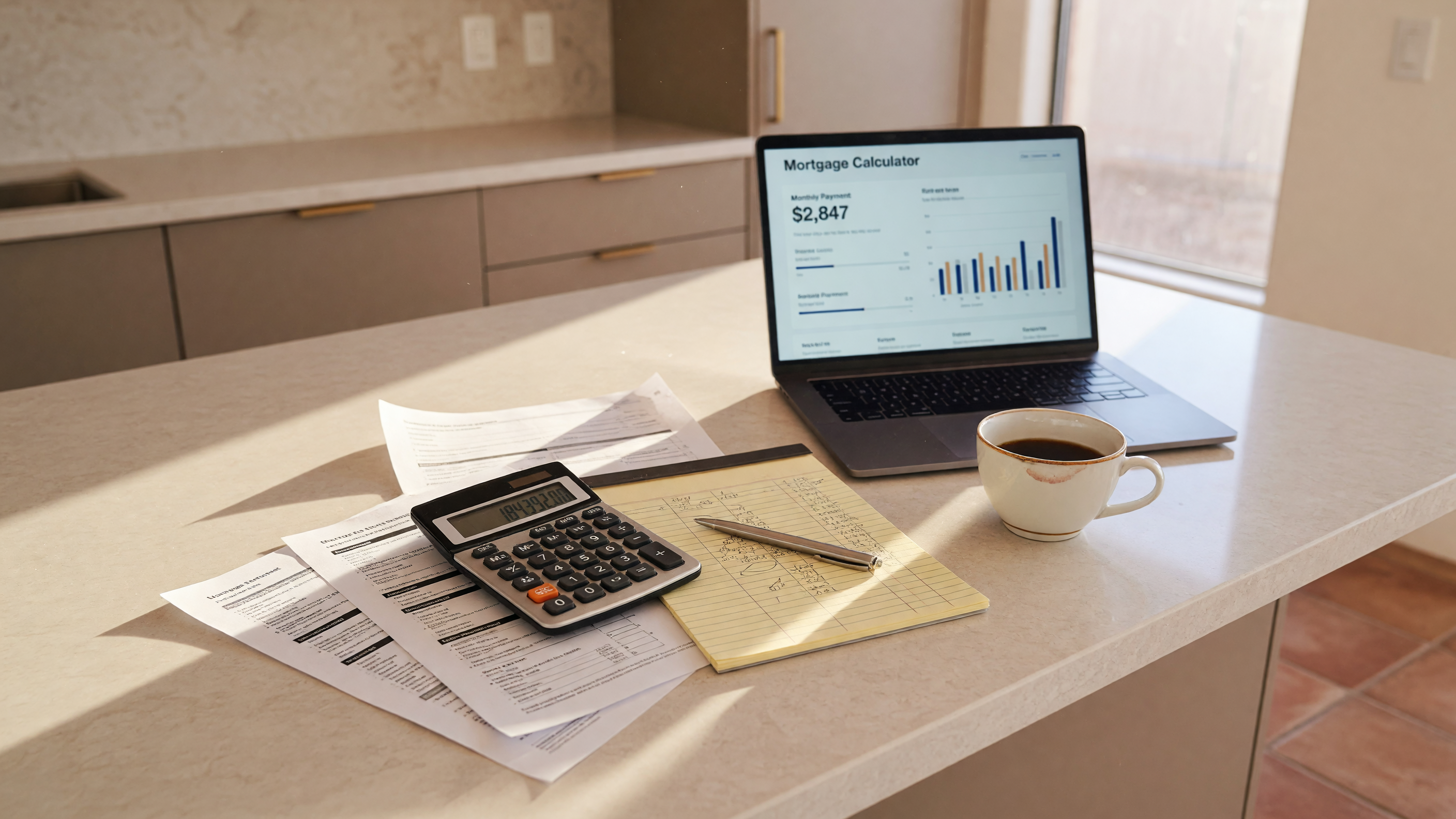
If you have been shopping for a home in the Las Vegas Valley over the past year, chances are you have had this conversation — with yourself, your spouse, or a friend over dinner — at least a dozen times: "Should we buy now, or wait until rates come down?"
It is the single most common question I hear from buyers right now, and it is a smart question to ask. The 30-year fixed mortgage rate is hovering around 6.0 to 6.5 percent as of June 2026, and while that is a significant improvement from the 7%+ peaks we saw in late 2023, it still feels high compared to the historic lows of 2020 through 2021. The instinct to wait is understandable.
But instinct is not the same as math. And when it comes to one of the largest financial decisions of your life, the math is what should drive the decision. So let me walk you through the actual numbers — no sales pitch, no pressure, just the analysis I walk through with every client who sits across from me and asks this question.
Scenario A: Buy a Home Today at 6.2%
Let us start with a concrete example. Say you are looking at a home in Henderson, Mountain's Edge, or Southwest Las Vegas priced at $450,000. You have saved for a down payment, you are pre-approved, and you find the right home today.
You are paying $2,485 per month in principal and interest. Not cheap, but here is what else is happening: you are building equity with every payment, your home is appreciating at roughly 3 to 4 percent per year based on current trends, and you locked in a purchase price before the market moves higher.
Scenario B: Wait One Year for Rates to Drop to 5.5%
Now let us assume you decide to wait. You have read the forecasts, and some analysts are projecting rates could drift into the mid-5% range by mid-2027 if inflation continues to cool. That seems like a win, right? Lower rate, lower monthly payment.
But here is what happens to the purchase price in the meantime.
Your monthly payment is about $107 lower. That sounds great — until you look at the full picture.
The Hidden Cost of Waiting: What the Headline Numbers Miss
Here is where the math gets real. While you saved $107 per month on your payment by waiting a year, you paid $15,750 more for the home itself. You also put down an additional $1,575 in down payment. And during the twelve months you waited, you either continued renting (spending $18,000 to $24,000+ in a Las Vegas rental market where the average one-bedroom runs $1,500 to $2,000 per month) or you missed twelve months of equity building and home appreciation.
- Monthly P&I: $2,485
- 12-month payments: $29,820
- Equity built in 12 months: ~$14,200
- Home appreciation (12 mo): ~$17,800
- Monthly P&I: $2,378
- 12-month payments: $28,536
- Equity built in 12 months: ~$13,800
- Home appreciation you missed: ~$15,750
- 12 months of rent paid: $18,000+
When you add it all up, the buyer who waited a year paid approximately $18,000 to $30,000 more in total cost — rent during the waiting period, higher purchase price, larger down payment — to save $107 per month. At that rate, it would take over 14 years of monthly savings just to break even on the decision to wait. And that assumes rates actually drop to 5.5%, which is far from guaranteed.
But What If Rates Drop Even Further — Say, to 5.0%?
Some buyers hold out hope for a return to sub-5% rates. Let us run that scenario too, because transparency matters.
If you wait two full years and rates drop to 5.0% by June 2028 — and home prices continue appreciating at 3.5% annually — that same $450,000 home is now priced at $482,113. Your loan amount is $433,901. Your monthly payment at 5.0% is $2,329.
You saved $156 per month compared to buying today. But you paid $32,113 more for the home, spent $36,000 to $48,000 in rent over two years, and missed out on two years of equity accumulation. The math does not work in your favor.
The Refinance Option Changes Everything
Here is the part of the equation that most buyers overlook, and it is the single most important reason why waiting for rates rarely makes financial sense: you can always refinance later.
If you buy today at 6.2% and rates drop to 5.5% in a year or two, you can refinance into a lower rate. Yes, refinancing comes with closing costs — typically $2,000 to $5,000 for a rate-and-term refinance. But those costs are a fraction of what you spend waiting and paying rent. And here is the critical difference: when you refinance, you are refinancing a home you already own, with equity you have already built, at a price you already locked in. You get the lower rate and the lower purchase price. The buyer who waited gets only the lower rate — at a higher purchase price.
What the Market Is Doing Right Now in Las Vegas
The math argument is one thing. The market dynamics add another layer.
As of June 2026, the Las Vegas Valley is in a genuinely balanced market. We are sitting at approximately 4.6 months of single-family home supply, with median days on market around 38 days. That means buyers have real options, real negotiating power, and real time to make thoughtful decisions. Roughly one-third of active listings have undergone at least one price reduction — a clear sign that sellers who overprice are being corrected by the market.
This kind of balanced market does not come along often in Las Vegas. During the frenzy of 2021 and 2022, buyers were waiving inspections, offering tens of thousands above asking price, and closing on homes they saw for fifteen minutes. That environment is gone — at least for now. The current market rewards patient, well-prepared buyers who can take their time, negotiate confidently, and make decisions based on data rather than fear.
But inventory levels and pricing dynamics are cyclical. New construction is expanding the valley's options right now, and builder incentives — including rate buydowns and closing cost credits — are effectively lowering the net cost of some homes by $15,000 to $30,000. Those incentives will not last forever. When rates do drop significantly, demand will surge, buyer competition will increase, and the negotiating leverage you enjoy today will evaporate.
When Waiting Actually Makes Sense
I would not be giving you honest advice if I said everyone should buy right now. There are legitimate reasons to wait:
- You are not financially ready. If your emergency fund is depleted after your down payment, if your credit score could use a few months of improvement, or if your debt-to-income ratio is tight, waiting six to twelve months to strengthen your financial position is wise. Buying a home you cannot comfortably afford is not wealth-building — it is a recipe for stress.
- Your job situation is uncertain. If you might relocate within the next two years, or if your income is不稳定, the transaction costs of buying and selling within a short window can erase any equity you build. Renting is the right call when your life situation is in flux.
- You have not found the right home. Buying just to "get in" at the right rate is a mistake. You should buy when you find a home that fits your budget, your lifestyle, and your long-term goals — not because a calendar date told you to.
My Bottom-Line Advice
I have been through enough market cycles to know that the buyers who fare best are not the ones who time the market perfectly — because nobody does. They are the ones who buy when the numbers make sense for their budget, secure a home they genuinely love, and hold it long enough for time and appreciation to work in their favor.
Right now, the Las Vegas Valley offers a rare combination: balanced inventory, negotiating room, stable prices, and builder incentives that effectively lower your cost of entry. You can refinance when rates drop, but you cannot go back in time and buy at last year's prices.
If you are sitting on the fence and wondering whether to make a move, I would love to run the real numbers for your specific situation — your budget, your target neighborhoods, your timeline. Not a generic calculator online, but an honest, personalized analysis that helps you decide with confidence. That is what I am here for, and there is no cost or pressure to the conversation.
The wait-versus-buy math depends on the ZIP you are watching: Henderson (89002, 89012, 89014, 89015, 89044, 89052, 89074), Mountain's Edge (89178), the Southwest (89139, 89141, 89148), and Summerlin (89135, 89138, 89144). Run the real numbers against live listings on my search: Search homes in the Las Vegas Valley.
Buy now, wait, or refinance later? Let us figure out what makes sense for you.
I will walk you through the actual math for your budget and target neighborhood — no pressure, no gimmicks, just the data you need to make a confident decision.