
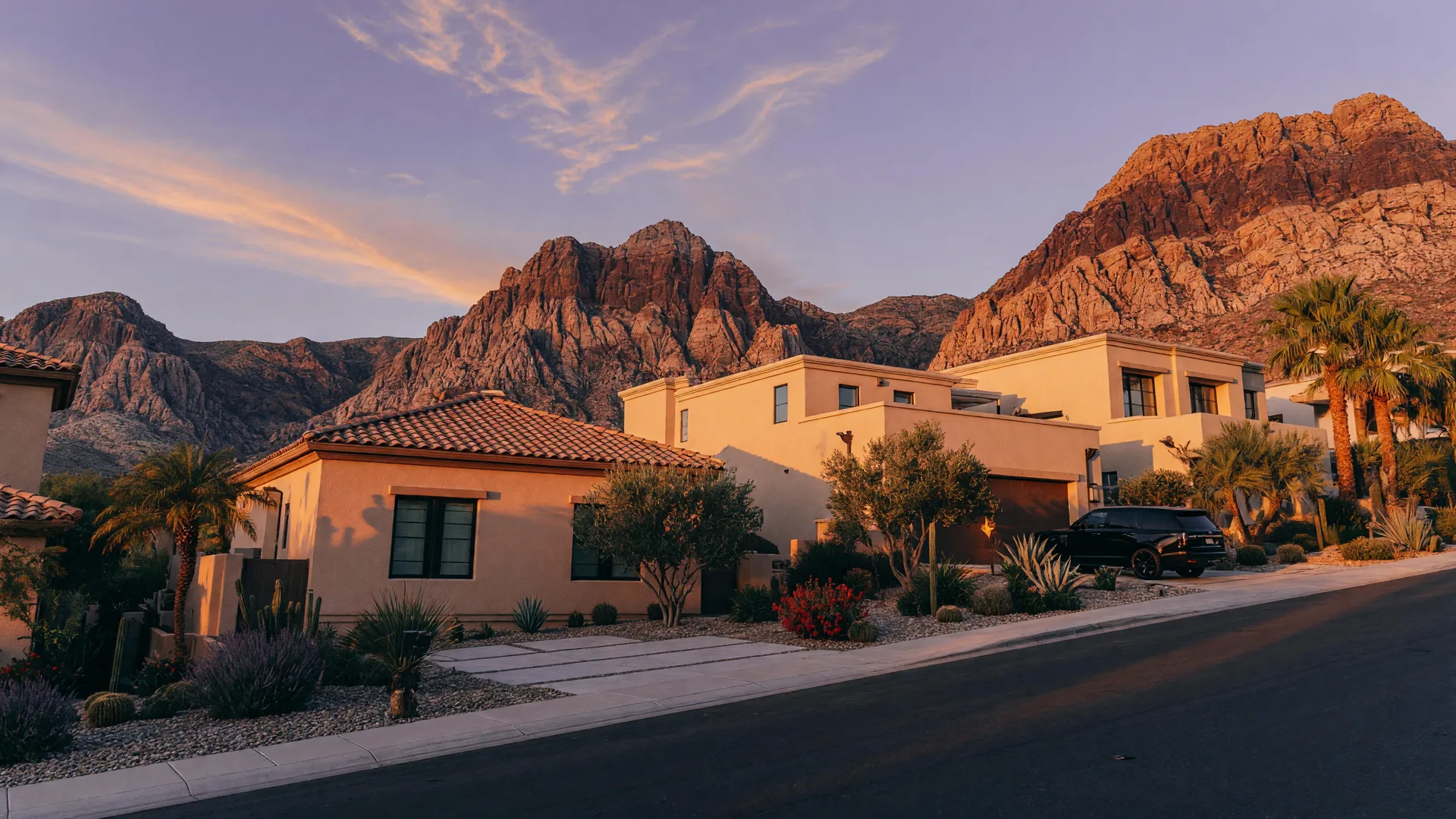
For decades, Summerlin has defined what premium living looks like in the Las Vegas Valley. From its master-planned villages and championship golf courses to the 90-acre Grand Park that opened earlier this year, the community has set the standard for thoughtful development, quality construction, and sustained home value appreciation.
But here is something every buyer, seller, and homeowner should know: Summerlin is approaching its final chapter. With developable land running out and only a few remaining villages left to build out, the community's endgame is reshaping the dynamics of supply, pricing, and long-term value across the entire valley.
The Numbers Tell the Story: Summerlin by the Numbers in 2026
To understand where Summerlin is headed, you need to understand the land math. The Howard Hughes Corporation, Summerlin's master developer, has been building this community for more than 30 years across approximately 22,500 acres. Today, most of those acres are spoken for. The remaining developable parcels are concentrated in the western portion of Summerlin, where the terrain becomes more challenging and the views become more spectacular.
What Remains: Luxury Villages in Higher Elevations
The next wave of Summerlin development is already taking shape in Summerlin West, where villages like Kestrel, Redpoint, and Grand Park Village are being built on higher-elevation terrain with sweeping views of Red Rock Canyon and the Spring Mountains. These are not entry-level neighborhoods. The homes here command prices well above $800,000, with many custom estates exceeding $1 million.
This is intentional. As land becomes scarce, each remaining parcel becomes more valuable. Developers are maximizing that value by building luxury product aimed at a premium buyer. The practical effect is that Summerlin's entry price point is rising, and the window to buy into this community at anything close to a moderate price is narrowing by the quarter.
If you have been considering Summerlin but have not yet made the move, the time to act is now. Not because prices will crash if you wait (they will not), but because the supply of moderately priced resale homes in established villages is finite and shrinking. As new construction shifts further up the price ladder, the existing homes in places like The Hills, The Arbors, and Summerlin South will continue to appreciate on the strength of scarcity alone.
Why Summerlin's Land Scarcity Matters for the Whole Valley
Summerlin's build-out does not just affect people who live there. It has ripple effects across every community in the Las Vegas Valley. When the valley's premier master-planned community reaches capacity, the buyers who would have moved to Summerlin start looking at alternatives. That means increased demand for Henderson communities like Green Valley and MacDonald Highlands, for Mountain's Edge, for Aliante, and for the new master-planned communities coming online in the southwest corridor.
This is already happening. Henderson's median home price has climbed to $540,000 in 2026, supported by a $2.5 billion development pipeline and strong demand from buyers who want Summerlin-level quality without the Summerlin price tag. Mountain's Edge continues to draw families with its excellent schools and the newly funded $43 million regional park expansion. The entire valley benefits from Summerlin's success, because that success raises the floor for every community.
What the Endgame Means for Summerlin Homeowners
If you already own a home in Summerlin, the land scarcity story is good news for your property value. Historically, master-planned communities that reach full build-out see sustained appreciation as the limited supply of existing homes competes for ongoing buyer demand. Summerlin is not unique in this pattern, but its position as the valley's premier address amplifies the effect.
With projected annual appreciation of 3 to 5 percent through the build-out period, Summerlin homes are likely to outperform the valley average in the coming years. This is particularly true for properties in the established eastern and central villages, where the mature landscaping, established schools, and walkable village centers cannot be replicated in the newer western development zones.
New State Water Rules Add Another Layer
In a related development, Nevada Assembly Bill 356 has taken effect, eliminating nonfunctional turf across the state and offering rebates for homeowners who convert to desert landscaping. For Summerlin homeowners, this is a meaningful consideration. The community has always emphasized desert-adapted landscaping, and many homeowners associations have already moved toward xeriscape requirements.
For buyers considering Summerlin, the new water rules mean lower ongoing maintenance costs and reduced water bills. For sellers, a home that has already completed a desert landscaping conversion can be a differentiator in a market where 43 percent of listings have price reductions. It signals that the property is modern, efficient, and aligned with Nevada's evolving environmental standards.
What Buyers Need to Know Right Now
If Summerlin is on your list, here is what I want you to understand about the current market.
First, inventory in Summerlin is tighter than the valley average. While the broader Las Vegas Valley has seen active listings climb to roughly 5,700 single-family homes, Summerlin has a disproportionately low share of that total. Many Summerlin homeowners are choosing to stay put rather than sell, knowing they would pay more to buy back into the same community or face paying a premium for an equivalent home elsewhere.
Second, new construction opportunities in Summerlin West offer a rare chance to buy new in a community that is almost built out. The villages of Kestrel and Grand Park Village still have inventory, and builders are offering incentives including rate buydowns and closing cost credits to move homes in the current market. If you are looking for a new home in Summerlin, this late 2026 window is likely the most favorable it will be.
Third, do not overlook the resale market in established villages. Homes in The Hills, The Arbors, Summerlin South, and the older villages near the 215 Beltway offer established trees, mature landscaping, and proximity to the community's best amenities — Trails Village Center, The Sports Park, and the new Grand Park. These homes are often more affordable per square foot than new construction and carry the added benefit of knowing exactly what the neighborhood looks like year-round.
My Perspective as a Local Agent
I have walked clients through more Summerlin homes than I can count. I have watched families choose between the new construction in Summerlin West and the established charm of a resale near The Trails. And I have seen the look on their faces when they realize that Summerlin is not growing forever.
This is not a call to rush into a decision you are not ready for. It is an invitation to look at the data with clear eyes. Summerlin is a finite resource. The land is running out. The homes that exist today will only become more valuable as the last villages sell out and the community shifts from development mode to legacy mode.
Whether you are a first-time buyer looking at a condo near Red Rock, a growing family seeking a four-bedroom in The Hills, or a homeowner considering whether now is the time to sell your Summerlin property, I can help you understand your options. The numbers are clear. The strategy depends on your goals.
Because land is the scarce resource, ZIP-level data matters here: Summerlin homes live mostly in 89135, 89138, and 89144, with nearby portions of 89134 and 89145. With inventory tightening, the fastest way to spot a new listing is my live search: Search homes in Summerlin.
Thinking About Summerlin? Let Us Talk.
Whether you are ready to explore homes in Summerlin West or want to understand what your current Summerlin home is worth in this market, I am here to give you straight answers and a clear plan.