
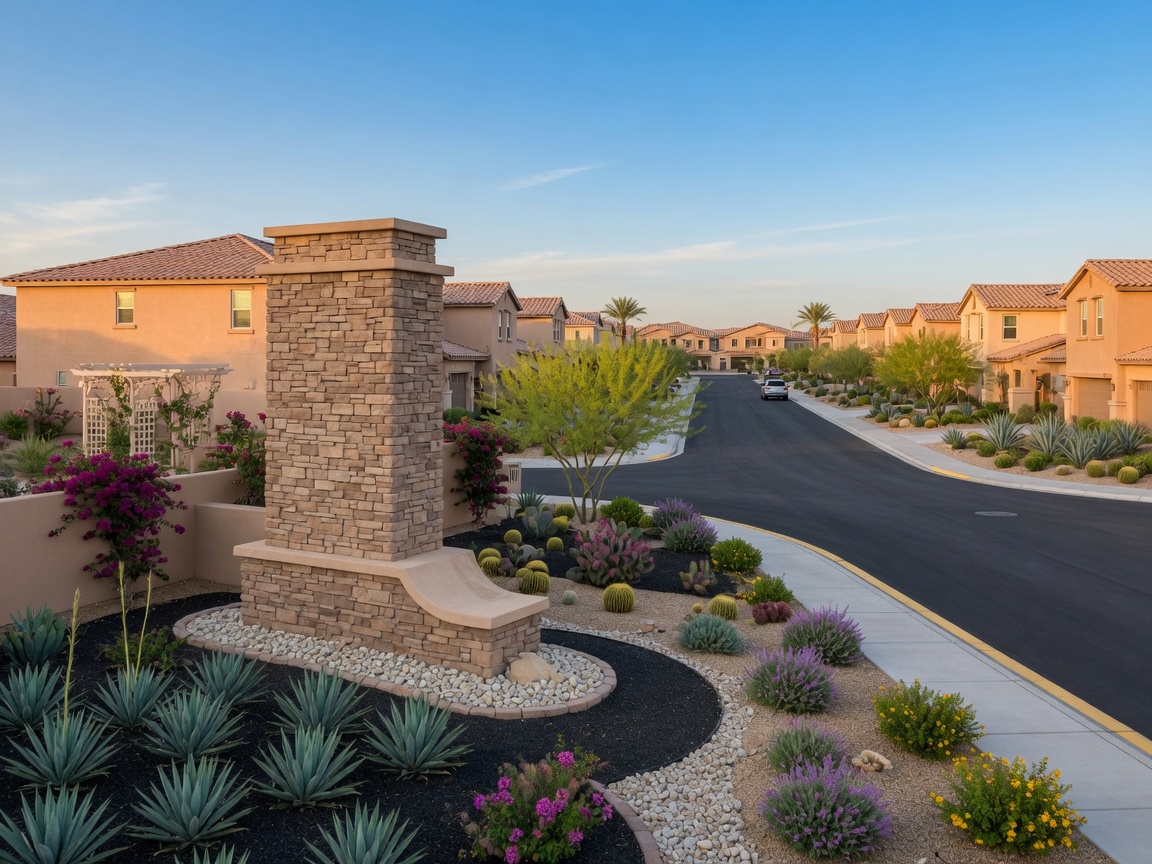
If you are buying a home in the Las Vegas Valley, there is a near certainty that you will be part of a homeowners association. Clark County has one of the highest concentrations of HOA-governed communities in the country, and for good reason — the desert climate demands ongoing landscaping, the master-planned communities that define this valley require infrastructure maintenance, and the amenities that draw people here (pools, parks, trails, guard gates) do not maintain themselves.
But here is what many first-time buyers — and even experienced homeowners — do not fully understand until it is too late: the monthly HOA fee you see on a listing is rarely the full picture. Between layered association fees, SID and LID assessments, and the possibility of special assessments, the true cost of living in a deed-restricted community can be significantly higher than the headline number suggests. This guide breaks it all down with real numbers so you can budget accurately and avoid surprises.
What HOA Fees Actually Cover
A homeowners association fee pays for the shared costs of maintaining a community. At the most basic level, that includes common area landscaping, street maintenance within the community, exterior lighting, and any shared amenities like pools, parks, tennis courts, or community centers. In guard-gated communities, the fee also covers security staffing.
The key thing to understand is that HOA fees vary dramatically based on what amenities the community offers and how well the association is funded. A simple community with a park and basic landscaping will cost far less to maintain than a resort-style community with multiple pools, a fitness center, and 24-hour guard staffing.
- Common area landscaping and irrigation
- Community pool and recreation center upkeep
- Street lighting and private road maintenance
- Parks, trails, and playground maintenance
- Guard gate and security services (if applicable)
- Community insurance and legal compliance
- Reserve fund for future capital repairs
- Exterior painting, roofing (in some communities)
Typical HOA Costs by Community (2026)
Here is a realistic breakdown of what you can expect to pay monthly across the major Las Vegas Valley communities. These are approximate ranges based on current data — your exact fee will depend on the specific village, sub-association, and amenity package.
Summerlin
Summerlin uses a two-tier HOA structure: a master association fee plus a sub-association (village) fee. As of January 2026, the master association fees are $74 per month for Summerlin North, $76 for Summerlin South, and $69 for Summerlin West. These include a $37 Summerlin Council assessment that funds community programming, trails, and open space maintenance.
The sub-association fees add another $40 to $350 per month depending on the village. For most buyers, the all-in monthly HOA cost in Summerlin ranges from $150 to $400. Guard-gated luxury communities like The Ridges or The Pointe can run $400 to $905 per month when you combine both tiers.
Henderson
Henderson HOA fees vary widely by master-planned community. In Green Valley Ranch, expect roughly $65 to $200+ per month. Cadence runs $100 to $300+ depending on the sub-area. Lake Las Vegas and Seven Hills, with their resort-level amenities, can range from $150 to $600+. The Water Street District area has lower HOA costs but fewer traditional community amenities.
Mountain's Edge & Southwest Las Vegas
Mountain's Edge is one of the more affordable HOA communities in the valley. The base HOA fee is approximately $40 per month, with sub-associations adding modest additional costs. Most homeowners pay a total of $100 to $200 per month all-in. This is one reason Mountain's Edge continues to be attractive to first-time buyers and young families — you get substantial parks, trails, and community amenities at a lower carrying cost.
Aliante & North Las Vegas
Aliante's HOA fees are moderate, typically in the $80 to $175 per month range. The community offers Aliante Nature Discovery Park, golf course access, and well-maintained common areas. As North Las Vegas continues to develop new communities near Alta Drive, newer subdivisions may carry slightly higher fees reflecting updated infrastructure.
SID and LID: The Fees Most Buyers Forget to Ask About
This is where many buyers get caught off guard. SID (Special Improvement District) and LID (Limited Improvement District) assessments are not part of your HOA fee. They are separate charges attached to your property to repay bonds that funded the public infrastructure in your community — roads, sewer lines, water systems, parks, and streetlights.
SIDs and LIDs are common in newer master-planned communities throughout the Las Vegas Valley, including Summerlin, Sky Canyon, Henderson, and Lake Las Vegas. They are typically billed semi-annually alongside your property taxes, and the remaining balance on the bond can range from $5,000 to $20,000 or more depending on the community and how much infrastructure was financed.
- Annual SID/LID payments typically range from $500 to $3,000+ per year, depending on the remaining bond balance and the repayment schedule.
- When you buy a home, you assume the remaining SID/LID balance. A newer home in a recently developed village may have a higher remaining balance than an older home where the bond is nearly paid off.
- SID/LID payments are in addition to your HOA fees, property taxes, and mortgage payment. Failing to account for them can add $40 to $250+ per month to your housing costs.
What to do: Before you make an offer on any home in a newer community, ask the seller or their agent for the remaining SID/LID balance and the annual payment amount. This number should be part of your total monthly housing cost calculation, right alongside your mortgage, taxes, insurance, and HOA fee.
Special Assessments: The Wild Card
A special assessment is a one-time charge levied by your HOA to cover an unexpected or large expense that the reserve fund cannot handle. Common triggers include major roof repairs on association-maintained buildings, repaving community roads, pool resurfacing, or repairing storm damage. Special assessments can range from a few hundred dollars to several thousand dollars per household, and in extreme cases, they can exceed $10,000.
The risk of special assessments is directly tied to the financial health of the HOA — specifically, whether the association has been adequately funding its reserve account. A community with a well-managed reserve fund and a recent reserve study is far less likely to hit homeowners with a surprise assessment than one that has been underfunding maintenance for years.
Five Questions to Ask Before You Buy
Whether you are buying your first home or your fifth, these are the questions I recommend asking about any HOA-governed property:
- 1What is the total all-in monthly HOA cost? Include both the master association and sub-association fees. If the listing says "$74 HOA," that is almost certainly only the master fee — ask for the complete number.
- 2What is the remaining SID/LID balance, and what is the annual payment? This will be on the seller's disclosure or available from the title company. Make sure it is part of your total monthly budget calculation.
- 3When was the last reserve study completed, and what percentage of the recommended funding level is the reserve currently at? A reserve fund below 70 percent of the recommended level is a red flag — it increases the likelihood of future special assessments.
- 4Are there any pending or planned special assessments? Ask directly. The HOA management company is required to disclose this information, and your agent can request it during the due diligence period.
- 5What are the HOA rules that affect you most? Review the CC&Rs (Covenants, Conditions, and Restrictions) for rules on exterior modifications, vehicle parking (including RVs and work vehicles), pet policies, short-term rentals, and landscaping requirements. An HOA rule that conflicts with your lifestyle is a dealbreaker that is better discovered before closing.
How to Read an HOA Financial Statement
When you are under contract, your agent can request the HOA's financial documents for your review. Here is what to look for:
- Annual budget vs. actual spending: A healthy association lives within its budget. If actual expenses consistently exceed the budget, fees are likely to increase.
- Reserve fund balance: Compare the current reserve balance to the amount recommended by the reserve study. A gap signals future fee increases or special assessments.
- Delinquency rate: If a significant percentage of homeowners are behind on dues, the association may have cash flow problems that affect services and maintenance.
- Recent or planned fee increases: A history of large, frequent fee increases suggests the association has been underfunding its obligations. Steady, modest increases are normal; dramatic jumps are not.
HOA Fees Are Not Inherently Bad
It is easy to focus on the cost of HOA fees, but it is worth remembering what they buy you. Well-managed HOAs maintain property values, provide amenities that would be prohibitively expensive as an individual homeowner, and handle the logistics of community upkeep that would otherwise fall on every homeowner individually.
In the Las Vegas Valley, where the desert climate creates unique maintenance challenges and the master-planned community model defines the housing landscape, a well-run HOA is an asset — not a burden. The key is knowing exactly what you are paying, what you are getting, and whether the association is financially healthy enough to sustain the community long-term.
When I work with buyers, I always request the full HOA financial package during the due diligence period and walk through it line by line. The goal is not to scare anyone away from an HOA community — it is to make sure you go in with open eyes and a clear budget. That is what informed homeownership looks like, and it is the foundation of building real wealth through your home.
The Bottom Line
HOA fees, SID/LID assessments, and special charges are a real and ongoing part of homeownership in the Las Vegas Valley. They are not something to fear, but they are something to understand. The more informed you are about these costs before you buy, the better positioned you will be to budget accurately, evaluate communities fairly, and protect your investment over the long term.
If you are looking at homes in Summerlin, Henderson, Mountain's Edge, Aliante, or anywhere in the valley and want help breaking down the true cost of homeownership in a specific community, I am always happy to sit down and walk through the numbers. No pressure — just clarity and honest guidance so your next move is the right one.
HOA fees and assessments differ by community and ZIP: Summerlin (89135, 89138, 89144), Henderson (89002, 89012, 89014, 89015, 89044, 89052, 89074), Mountain's Edge (89178), Aliante (89084), and the Southwest (89139, 89141, 89148). Compare actual listings on my live search: Search homes in the Las Vegas Valley.
I will help you understand the full cost of homeownership in any community.
From HOA fees and SID/LID assessments to reserve fund health, I break down every cost so you can budget with confidence and avoid surprises after closing.