
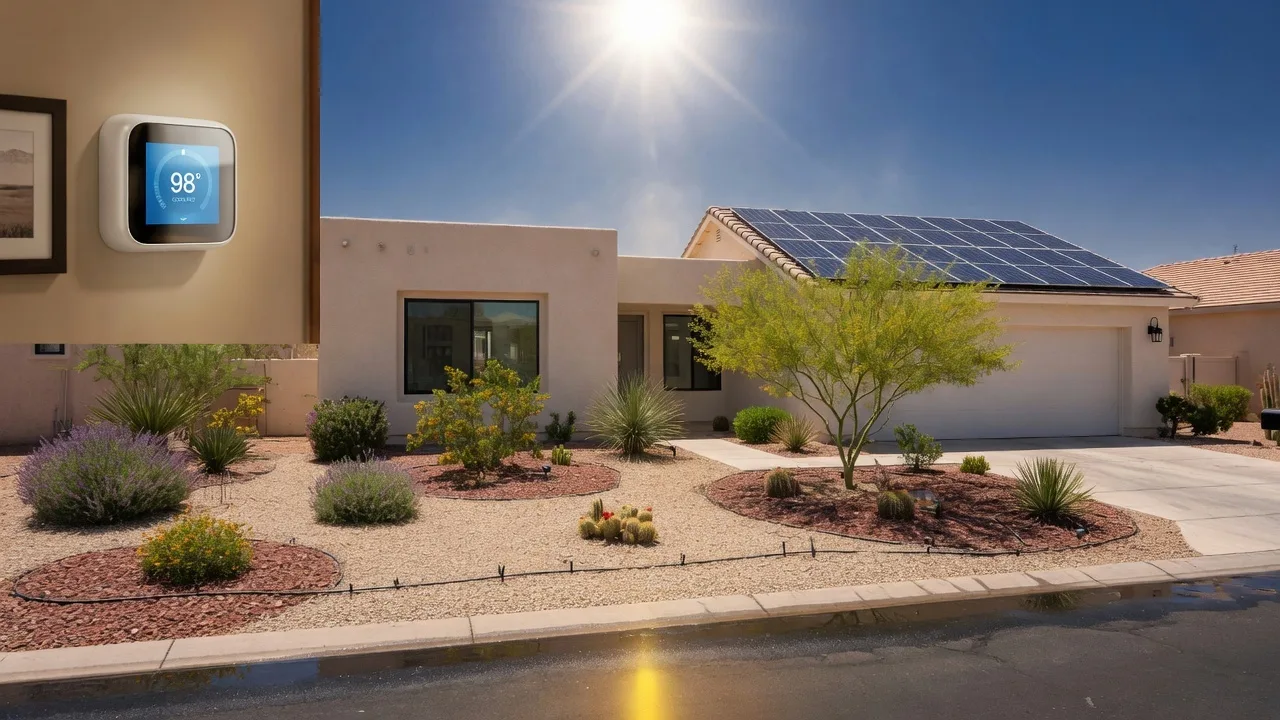
Every summer in Las Vegas, homeowners face the same reality: triple-digit temperatures for weeks on end, air conditioning systems running around the clock, and electric bills that spike hard enough to make your jaw drop. The average Las Vegas household spends between $300 and $450 per month on electricity during peak summer months — and for larger homes or older systems, that number can climb significantly higher.
But here is the thing: a meaningful portion of that cost is preventable. I am not talking about expensive renovations or solar panel installations — though those have their place. I am talking about practical, relatively low-cost steps that any homeowner can take right now to reduce their summer energy bills without sacrificing comfort. As someone who is passionate about helping my clients build real wealth through homeownership, reducing your recurring costs is one of the most overlooked ways to protect your financial position.
Here is my comprehensive guide to beating the Las Vegas summer heat efficiently — what to do, what it costs, and what it saves.
1. HVAC Maintenance: The $150 Fix That Saves $180 to $300 a Year
Your heating, ventilation, and air conditioning system is the single biggest consumer of energy in your home — it accounts for roughly 60 percent of total energy use during a Las Vegas summer. A well-maintained HVAC system uses 10 to 25 percent less energy than a neglected one. The math is straightforward: a $150 to $200 professional tune-up twice a year can save you $180 to $300 annually on your electric bills, and it extends the life of a system that costs $8,000 to $15,000 to replace.
What a Professional Tune-Up Should Include
- Refrigerant check and charge. Low refrigerant levels force the system to work harder and cool less efficiently. A technician should check for leaks and top off the charge if needed.
- Coil cleaning. The evaporator and condenser coils accumulate dust and debris over time, reducing heat transfer efficiency. Cleaning them restores performance.
- Filter replacement. In a desert environment, HVAC filters clog faster than in other climates. Replace them every 30 to 60 days during summer — not the standard 90-day interval that works in milder regions.
- Duct inspection. Leaky or poorly insulated ducts can waste 20 to 30 percent of conditioned air before it reaches your living space. A technician should check for disconnections, gaps, and insulation damage.
If you have not had your system serviced before summer hits, schedule it now. The difference in comfort and cost between a maintained and a neglected system is dramatic — and the investment pays for itself within the first cooling season.
2. Smart Thermostats: The Easiest $300 Annual Savings
A smart thermostat is one of the simplest, most cost-effective upgrades a Las Vegas homeowner can make. Devices like the Nest Learning Thermostat or Ecobee SmartThermostat learn your schedule and automatically adjust temperatures when you are away or sleeping. NV Energy estimates that smart thermostats can reduce cooling costs by up to 15 percent — which translates to $300 or more per year for the average Las Vegas home.
How to Maximize Your Smart Thermostat Savings
- Set it and forget it at 78°F. The Department of Energy recommends 78°F as the optimal cooling temperature when you are home. Every degree below 78 increases your energy consumption by roughly 3 percent.
- Raise the setpoint when you leave. Set the thermostat to 82°F to 85°F when you are away. A smart thermostat can start cooling the house back down before you return, so you walk into a comfortable home without wasting energy all day.
- Use geofencing. Many smart thermostats detect when your phone leaves the house and automatically enter away mode. This eliminates the biggest source of wasted cooling energy: running the AC at full capacity in an empty house.
3. Insulation and Windows: The Frontline Defense
In a desert climate, the biggest energy challenge is keeping hot air out and cool air in. Your home's insulation and windows are the primary battleground. The good news: even modest improvements in these areas can produce outsized results.
- Attic insulation is the single most impactful upgrade. Heat rises — or more accurately in Las Vegas, heat pushes down from the roof into your attic, which then radiates into your living space. Most Las Vegas homes should have R-38 to R-60 attic insulation (approximately 10 to 20 inches of blown-in fiberglass or cellulose). If your attic insulation is thin or compressed, adding more is one of the highest-return energy investments you can make. Cost: $1,500 to $3,000. Savings: $200 to $500 per year.
- Window treatments matter more than you think. Solar heat gain through windows accounts for up to 30 percent of residential cooling loads. Reflective or blackout window coverings — particularly on west- and south-facing windows — can reduce heat gain by 40 to 70 percent. The cost ranges from $30 to $100 per window for cellular shades or $150 to $400 for reflective roller shades. If your budget allows, dual-pane low-emissivity (low-e) windows offer even better performance, with installed costs of $300 to $600 per window.
- Seal air leaks. Caulk around window frames, weatherstrip doors, and seal gaps around electrical outlets and plumbing penetrations. Air leaks can account for 10 to 15 percent of your cooling load, and the fixes cost almost nothing in materials.
4. Desert Landscaping: Save Water, Lower Temperatures, Cut Bills
In Las Vegas, water-efficient landscaping — commonly called xeriscaping — does double duty. It reduces your water bill, which is significant in a desert climate where outdoor water use can account for 50 to 70 percent of total household consumption during summer. And it reduces the ambient temperature around your home, which decreases cooling load.
What to Plant and How to Save
- Choose native and drought-tolerant plants. Desert marigold, red yucca, lantana, bougainvillea, and agave thrive in Las Vegas heat with minimal water. These plants are adapted to our climate and require a fraction of the irrigation that traditional turf demands.
- Replace grass with gravel, rock, or artificial turf. Natural grass in Las Vegas requires approximately 75 gallons of water per square foot per year. Gravel or decomposed granite requires zero. The Southern Nevada Water Authority's Water Smart Landscapes program offers rebates for turf conversion — up to $3 per square foot for commercial properties and varying amounts for residential.
- Install drip irrigation. Drip systems deliver water directly to plant roots with minimal evaporation loss — they are 30 to 50 percent more efficient than traditional spray sprinklers. A basic drip system for a front yard can be installed for $500 to $1,500.
- Use mulch. Two to three inches of wood chip or rock mulch around plants reduces soil temperature, retains moisture, and cuts evaporation by up to 70 percent.
5. Solar Panels: The Long-Term Play
Solar panels are a significant investment — typically $15,000 to $30,000 before incentives for a residential system — but in Las Vegas, the economics are among the most favorable in the country. The valley averages over 300 sunny days per year, and NV Energy's net metering program (restored under AB 405) credits you for excess solar generation at approximately 75 percent of the retail rate.
Solar Economics in 2026: What to Know
- Federal tax credit (ITC): The 30 percent Federal Solar Tax Credit expired on December 31, 2025. Systems installed in 2026 do not qualify for the federal credit. This is a meaningful change — it removes approximately $4,500 to $9,000 in potential savings from a typical residential installation.
- NV Energy rebates: NV Energy offers up to $3,000 for solar water heating systems. Southwest Gas also provides up to $3,500 for solar water heating and cash-back incentives for efficient water heaters (up to $225). These are limited, so check current availability before planning your project.
- Net metering: Under AB 405, NV Energy credits excess solar generation at roughly 75 percent of the retail rate. A properly sized system can eliminate or significantly reduce your summer electric bill, and the credits generated during peak production months carry over to offset lower-production periods.
Without the federal tax credit, the payback period for a new solar installation in 2026 is longer than it was in 2025 — typically 8 to 12 years rather than 6 to 9. For homeowners who plan to stay in their home for the long term, solar still makes financial sense in Las Vegas. For those who may sell within five years, the return is less certain, though solar-equipped homes do tend to sell faster and at a modest premium.
My recommendation: get at least three quotes from licensed installers, ask about financing options (including the Nevada Clean Energy Fund's low-interest energy upgrade loans), and run the numbers for your specific home and usage pattern before deciding.
6. Quick Wins: Small Changes, Big Impact
Not every energy-saving measure requires a big investment. Here are some immediate, low-cost steps that can reduce your summer bills starting this month:
- Close blinds during peak hours. Between 10 a.m. and 4 p.m., close blinds and curtains on south- and west-facing windows. This alone can reduce cooling costs by 5 to 10 percent.
- Use ceiling fans strategically. Fans cool people, not rooms. Run them in occupied rooms to feel 3 to 4 degrees cooler, which lets you raise the thermostat setting without sacrificing comfort.
- Avoid using the oven during peak heat. Running the oven at 350°F to 400°F can raise your kitchen temperature by 5 to 10 degrees, forcing the AC to work harder. Grill outside, use the microwave, or cook during cooler morning hours.
- Switch to LED bulbs. LED bulbs use 75 percent less energy than incandescent bulbs and produce far less heat. In a desert home, reduced heat output from lighting is a secondary but real benefit.
- Flush your water heater. Las Vegas water is hard, and sediment builds up in your water heater tank over time, reducing efficiency. Flushing the tank once a year costs nothing and can improve energy performance by 10 to 15 percent.
The ROI of Energy Efficiency: Why It Matters for Your Home's Value
There is a reason I dedicate time to energy efficiency as a real estate agent, not just as a homeowner advocate: it directly impacts your home's market value. In the Las Vegas Valley, where summer cooling costs are a significant line item in every buyer's budget, energy-efficient homes sell faster and for more money. Buyers ask about HVAC age, insulation levels, and monthly utility costs during every showing. A home with a modern HVAC system, smart thermostat, updated insulation, and desert landscaping is positioned to sell at a premium compared to a comparable home with an aging AC unit and a thirsty grass yard.
The National Association of Realtors consistently finds that energy-efficient upgrades deliver among the highest returns on investment of any home improvement category. In the Las Vegas market specifically, a new HVAC system, desert landscaping conversion, and smart home technology package can collectively add $15,000 to $25,000 in perceived and actual value — while costing far less than a kitchen remodel or bathroom renovation.
The Bottom Line
Living in Las Vegas means living with extreme heat — that is not changing. But the cost of that heat is something you can control. A well-maintained HVAC system, a smart thermostat, proper insulation, desert landscaping, and a few simple behavioral changes can collectively reduce your summer energy bills by $500 to $1,500 or more per year. Over a decade, that is $5,000 to $15,000 back in your pocket — real money that compounds when invested or applied toward your mortgage principal.
Energy efficiency is not glamorous. It does not make for great Instagram content. But it is one of the most consistent, reliable ways to build wealth as a homeowner — and it starts with taking an honest look at where your money is going and what you can do about it starting today.
If you are a Las Vegas homeowner looking to improve your home's efficiency — or if you are buying a home and want to evaluate its energy profile before you make an offer — I am here to help. I can connect you with trusted local contractors, walk you through the available rebates and financing options, and make sure your next investment in your home pays real dividends. No pressure, no sales pitch — just the kind of practical guidance that protects your bottom line.
Newer, more efficient homes cluster in ZIPs like the Southwest (89139, 89141, 89148). If efficiency is a priority, browse what is currently listed there on my live search: Search homes in the Las Vegas Valley.
Let me connect you with the right resources and contractors.
Whether you want to upgrade your HVAC, explore solar options, convert your yard to desert landscaping, or evaluate a home's energy profile before buying, I can help you make smart, cost-effective decisions.