
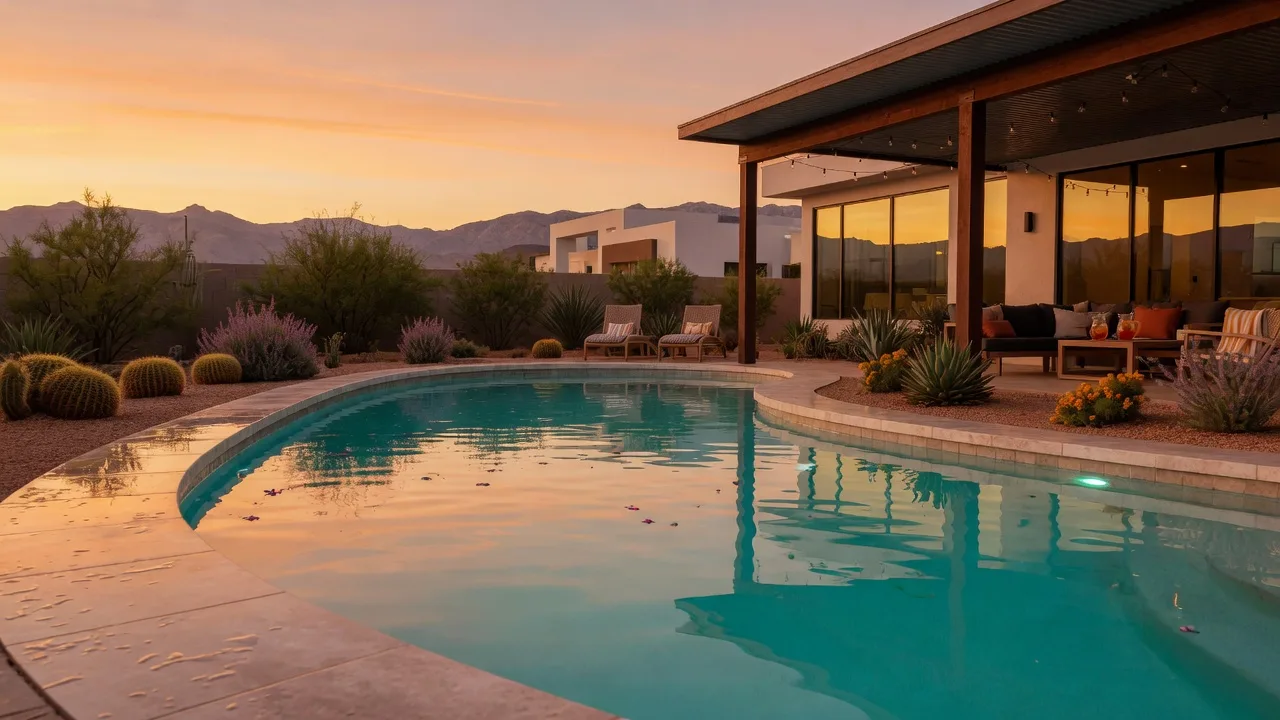
In Las Vegas, a swimming pool is practically a lifestyle staple. The valley averages over 300 days of sunshine a year, summer temperatures routinely exceed 110°F, and many neighborhoods — from Summerlin to Mountain's Edge to Henderson — are designed with pool-ready backyards as standard. According to industry estimates, roughly 40 to 50 percent of single-family homes in the Las Vegas Valley have a pool.
But here is what many homeowners do not fully appreciate until they own one: a pool is not just a backyard feature — it is a financial commitment. And in the Las Vegas desert, that commitment is higher than in most other parts of the country. If you are buying a home with a pool, budgeting for a pool, or wondering whether your pool is worth the ongoing cost, this guide breaks down the real numbers for 2026.
Monthly Operating Costs: The Numbers Most People Underestimate
The monthly cost of running a pool in Las Vegas depends on size, equipment efficiency, and how well you maintain it — but the baseline is higher than most new pool owners expect. Here is what the typical Las Vegas homeowner spends each month during the peak swimming season (May through September):
- Electricity (pool pump): A single-speed pump running 8 to 12 hours a day can add $150 to $400 per month to your NV Energy bill during summer. Upgrading to a variable-speed pump can cut that by 50 to 80 percent — one of the single best investments a pool owner can make.
- Water: Las Vegas loses approximately half an inch of pool water per day to evaporation in peak summer. That translates to roughly 1,000 to 3,000 gallons per month in replacement water — adding $30 to $100+ to your monthly water bill, depending on your SNWA tier.
- Chemicals: Chlorine, muriatic acid, pH balancers, and algaecide run approximately $50 to $100 per month for self-maintained pools. Las Vegas's hard water and intense UV exposure increase chemical demand compared to other climates.
- Professional maintenance: If you hire a weekly pool service (recommended for most homeowners), expect to pay $120 to $250 per month during summer for cleaning, chemical balancing, and basic equipment checks.
Add it up: a typical Las Vegas pool costs $250 to $750 per month to operate during peak season — roughly $1,500 to $4,000 for the five-month summer period alone. During the cooler months (October through April), costs drop significantly, but you still have pump electricity, occasional chemicals, and water maintenance.
Annual Budget: What You Should Plan For
When you look at the full year, pool ownership in Las Vegas typically falls into these ranges:
- Self-maintained pool (DIY): $3,000 to $4,500 per year in electricity, water, chemicals, and occasional part replacements. This assumes a variable-speed pump and basic weekly maintenance by the homeowner.
- Professionally maintained pool: $4,500 to $7,000 per year when you include a monthly service contract on top of utilities. This is the most common scenario for busy families and is the range I see most often.
- Older pool with dated equipment: $6,000 to $10,000+ per year when you factor in frequent repairs, higher energy consumption from inefficient pumps, and water waste from leaky plumbing or cracked tiles. This is the scenario that surprises people most.
The Big Expenses: Equipment Replacement and Repairs
Beyond the monthly operating costs, pool equipment has a finite lifespan — and in the Las Vegas heat, components degrade faster than in milder climates. Here are the major replacement costs every pool owner should plan for:
- Pool pump: $1,200 to $3,500 for a variable-speed replacement, installed. Single-speed pumps last 5 to 8 years; variable-speed pumps last 8 to 12 years.
- Pool heater: $2,500 to $5,000 for a new gas or heat-pump unit. Heaters last 7 to 12 years and are essential if you want to swim from October through April.
- Plaster/resurfacing: $5,000 to $15,000 depending on pool size and finish type. Pool surfaces last 10 to 15 years in Las Vegas before needing resurfacing. Pebble finishes last longer than standard plaster.
- Tile and coping: $2,000 to $6,000 for replacement around the waterline and deck edge. Calcium buildup from Las Vegas hard water accelerates tile deterioration.
- Pool deck/pavers: $3,000 to $10,000+ for replacement or resurfacing. Extreme heat cycles cause cracking and settling over time.
- Leak detection and repair: $200 to $500 for detection; $500 to $3,000+ for repairs. Leaks are common in older pools and can waste thousands of gallons of water per month.
The practical takeaway: set aside a pool reserve fund of at least $1,000 to $2,000 per year for unexpected repairs. Pool equipment rarely fails on a convenient schedule, and in the Las Vegas summer, a pump failure in July means you need it fixed immediately — not when it is convenient for your budget.
How Pool Ownership Affects Your Home's Value
The value question is more nuanced than most people think. In Las Vegas, a pool is expected in many neighborhoods — particularly in Summerlin, Henderson, and the higher-end communities in the southwest. In these areas, a home without a pool may actually sell for less because buyers expect one. But in more affordable areas like Aliante or parts of North Las Vegas, a pool can be a dividing feature: some buyers see it as a plus, while others see it as a maintenance burden.
- Resale value increase: A well-maintained pool can add 5 to 8 percent to a home's sale price in Las Vegas — more in luxury neighborhoods, less in entry-level areas.
- Days on market: Homes with pools in Summerlin and Henderson sell at similar or faster speeds than comparable homes without pools. In North Las Vegas, the effect is more variable.
- Condition matters: A pool in excellent condition adds value. A neglected pool with cracked plaster, green water, and broken equipment actually detracts from value because buyers factor in the $10,000 to $20,000+ repair cost.
Smart Strategies to Reduce Your Pool Costs
Pool ownership is a commitment, but there are concrete strategies to keep costs under control:
Energy and Equipment Savings
- Install a variable-speed pump. This is the single highest-impact upgrade. NV Energy's PowerShift rebates offer $300 to $1,200 toward qualifying pool pump replacements in 2026. The pump pays for itself in energy savings within 12 to 18 months.
- Use a pool cover. A solar or thermal pool cover reduces evaporation by up to 95 percent and can cut heating costs by 50 to 70 percent. In a desert climate, it is the simplest and cheapest way to save water and money.
- Set your pump schedule wisely. Run the pump during off-peak hours (9 PM to 6 AM) when NV Energy rates are lower. Most variable-speed pumps can be programmed for optimal scheduling.
- Switch to LED pool lighting. LED lights use 75 percent less energy than incandescent pool lights and last five to ten times longer. A typical LED pool light upgrade costs $200 to $400.
Water Conservation Strategies
- Monitor water levels weekly. Las Vegas's extreme evaporation means you should check and adjust water levels every week during summer. Keeping the water at the proper level prevents pump damage and reduces water waste.
- Check for leaks proactively. If your pool is losing more than half an inch of water per day, you likely have a leak. The Southern Nevada Water Authority offers free water audits for residential customers — use them.
- Backwash wisely. Sand and DE filters need backwashing, but overdoing it wastes hundreds of gallons. Follow manufacturer guidelines and consider switching to a cartridge filter, which uses no water to clean.
Preventive Maintenance Saves Thousands
- Schedule a spring tune-up. A $150 to $250 professional inspection before summer — checking refrigerant, electrical connections, pump seals, and drain lines — can prevent a $3,000+ emergency repair in July.
- Keep chemistry balanced. Unbalanced water (especially low pH or high calcium hardness) corrodes equipment and damages plaster. Testing weekly and adjusting chemicals prevents costly long-term damage.
- Winterize carefully. Even in Las Vegas, pool equipment benefits from winter preparation. Cover the pool, reduce pump run time, and protect exposed pipes during the rare freeze events.
Should You Buy a Home With a Pool — or Add One?
If you are house hunting in Las Vegas, here is my practical advice on the pool question:
- If you have kids or entertain regularly: A pool is likely worth the cost. In Las Vegas, it extends your usable living space for 8 to 9 months of the year. Budget $4,000 to $6,000 annually for maintenance and you will not be surprised.
- If you travel frequently or rarely swim: Consider whether the ongoing cost is worth it. A community pool or gym membership may serve you better at a fraction of the price. Some homeowners let their pool go — and a neglected pool costs more to restore than to maintain.
- If you are buying a home with an older pool: Get a thorough pool inspection before closing. Check the equipment age, plaster condition, tile integrity, and plumbing. A $300 pool inspection now can prevent a $15,000 surprise after closing.
- If you are considering adding a pool: New pool construction in Las Vegas runs $50,000 to $120,000+ depending on size, finish, and features. Factor in permits, HOA approvals, and a 3- to 6-month construction timeline. A pool rarely pays for itself purely in resale value — it pays in lifestyle.
The Bottom Line
Owning a pool in Las Vegas is a genuine lifestyle investment — and like any investment, it requires ongoing attention and a realistic budget. The total annual cost of pool ownership typically ranges from $3,000 to $7,000 for a well-maintained pool, with occasional major expenses of $5,000 to $15,000+ for equipment replacement or resurfacing.
The good news is that smart upgrades — variable-speed pumps, pool covers, LED lighting, and consistent preventive maintenance — can significantly reduce your operating costs and extend the life of your equipment. And in a market where pools are expected in many of the valley's most desirable neighborhoods, a well-maintained pool is a genuine asset when it comes time to sell.
If you are buying a home with a pool and want an honest assessment of its condition and long-term costs — or if you are considering adding a pool to your current property — I am here to help you think through the numbers. Understanding the true cost upfront is always better than discovering it after the fact.
Pool homes cluster in certain ZIPs: Summerlin (89135, 89138, 89144), Henderson (89002, 89012, 89014, 89015, 89044, 89052, 89074), Mountain's Edge (89178), Aliante (89084), and North Las Vegas (89030, 89031, 89032, 89081, 89084, 89086). See which homes fit your pool budget on my live search: Search homes in the Las Vegas Valley.
Let us talk about what makes sense for your goals.
Whether you are evaluating a pool, budgeting for homeownership costs, or thinking about your next move in the Las Vegas market, I am here to give you honest, data-backed guidance. No pressure — just clarity.